

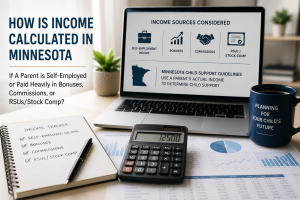
 If your paycheck looks the same every two weeks, calculating child support or spousal maintenance in Minnesota is fairly mechanical. But if you’re self-employed, run a business, or your compensation comes loaded with bonuses, commissions, or restricted stock units, the math gets a lot less predictable. That unpredictability is exactly where a lot of Minnesota divorce and support cases get contentious.
Here’s how Minnesota law actually approaches these income sources, and why “what did you make last year” is rarely the end of the conversation.
The Starting Point: Gross Income Under Minnesota Law
Minnesota child support calculations begin with gross income, defined broadly under Minn. Stat. § 518A.29. This statute is intentionally wide. It includes salaries, wages, and commissions, but also self-employment income, spousal maintenance received, pension and disability payments, and several other categories. The idea is to capture the full financial picture, not just a base salary.
For W-2 employees with steady pay, this is straightforward. For anyone with variable or business-based income, it takes more digging, and often more documentation, to get an accurate number.
Self-Employment And Business Income
If you or your co-parent own a business, are a partner in a firm, or work as an independent contractor, Minnesota courts don’t just look at your tax return’s bottom line. Under Minn. Stat. § 518A.30, self-employment income for child support purposes is calculated as:
- Gross receipts
- Minus cost of goods sold
- Minus ordinary and necessary business expenses
That last category is where most disputes happen. Tax law and family law don’t always agree on what counts as a legitimate business expense. The statute specifically excludes certain items from being deducted when calculating income for support purposes, including accelerated depreciation and investment tax credits allowed by the IRS. A judge can also disregard any other business expense found to be inappropriate or excessive for support calculation purposes, even if it was a valid deduction on the tax return.
In practice, this means expenses like a vehicle used partly for personal errands, a phone plan, meals, or a home office deduction may get added back into income even though they lowered the taxable profit. If you’re the one claiming these deductions, you carry the burden of proving they were genuinely ordinary and necessary for the business, not personal expenses run through the company.
Why Self-Employment Cases Often Need More Than A Tax Return
A single year’s Schedule C rarely tells the whole story, especially for business owners in industries with seasonal swings, or for small business owners in a college town like Northfield or a resort community up on the North Shore where income might genuinely fluctuate month to month for legitimate reasons. Courts often want to see multiple years of returns, profit and loss statements, and sometimes bank records, to distinguish real variability from an attempt to minimize reported income around the time of a divorce filing.
Bonuses And Commissions
Bonuses and commissions are included in gross income under Minnesota’s child support statute, but they create a practical problem: they’re often irregular. Someone earning a base salary plus a variable annual bonus, or a commission-based salesperson whose income swings from month to month, doesn’t fit neatly into a “monthly income” box.
Courts and practitioners typically address this by averaging income over a representative period, often using recent years of W-2s, 1099s, or pay stubs to establish a realistic monthly figure. If your commission income has been trending sharply up or down, that trend itself can become a point of argument. One side may push for using a recent, higher-earning period; the other may argue for a longer average to smooth out an unusually good or unusually bad year.
This is also where potential income under Minn. Stat. § 518A.32 sometimes comes into play, particularly if a parent appears to have voluntarily reduced their commission-based work or hours around the time support is being calculated.
RSUs And Stock Compensation
Restricted stock units and other equity compensation are increasingly common for professionals working at companies with a presence in the Twin Cities corporate corridor, and they raise questions Minnesota’s statutes don’t answer with a bright-line rule. A few recurring issues:
- Timing: Is the income counted when RSUs vest, or when they’re actually sold and converted to cash?
- Valuation: Stock price fluctuates, so the value on the vest date may look very different from the value months later.
- Recurring vs. one-time: A single vesting event tied to a signing bonus is treated differently than a regular, predictable equity grant that functions like part of an annual compensation package.
Because equity compensation isn’t spelled out in detail in the child support statute the way self-employment income is, how it gets treated often depends on the specific facts, the structure of the compensation plan, and how the numbers are presented to the court. This is an area where getting it wrong, in either direction, can meaningfully skew a support or maintenance calculation for years.
What This Means If You’re Heading Into A Minnesota Divorce
If your or your co-parent’s income includes any of these variable elements, a few things are worth doing early:
- Pull multiple years of documentation, not just the most recent tax return. Two or three years gives a more honest picture of typical income.
- Separate legitimate business expenses from personal ones if you’re self-employed, before a judge or opposing counsel does it for you.
- Track vesting schedules and grant agreements for RSUs or stock options, since the plan documents often matter as much as the pay stubs.
- Don’t assume a single bad or good month or year sets the standard. Courts generally look for a representative pattern, not a snapshot.
How Heimerl & Lammers Approaches Income Disputes
Cases involving self-employment income, commission structures, or equity compensation take more than plugging numbers into a worksheet. They take a willingness to dig into financial documents, ask the right questions of accountants or business valuators when needed, and prepare the case as though a judge may ultimately have to decide the number, because sometimes that’s exactly what happens.
Our family law team includes a Board-Certified Family Trial Advocate, certified by the National Board of Trial Advocacy, along with a Fellow of the American Academy of Matrimonial Lawyers. That depth of experience matters most in exactly these situations, where the “right” income figure isn’t obvious from the paperwork and requires someone who has actually litigated these disputes in Hennepin County and courts across Minnesota to know where the pressure points are.
Talk To Someone Before The Numbers Get Finalized
Income disputes involving self-employment, bonuses, or stock compensation can shape a support order for years, so it’s worth getting the calculation right the first time rather than trying to fix it later through a modification. If you have questions about how your specific income situation might be treated, the Minneapolis child support lawyers at Heimerl & Lammers are here to talk it through. Reach out by phone, email, or text to discuss your options.
This blog post is for informational purposes only and does not constitute legal advice. Every family law case involves unique facts. Contact Heimerl & Lammers to discuss your specific situation.